Priced in the dark.
No public pricing anywhere in the category. Every figure is a private negotiation sized for a car maker’s budget, far above what a city can carry.
The stack
A complete V2X software stack: the full ETSI and 3GPP C-ITS stack covering awareness, hazard, signalised intersection, security and edge, with facilities and trust of our own, independent of the radio underneath. The capability the enterprise automotive stacks reserve for OEMs, built for the roadside and priced for the cities that run it.
The gap
The connected-vehicle software market grew up around car makers. That leaves the people who own the actual infrastructure (cities, road operators, signal authorities) buying the leftovers.
No public pricing anywhere in the category. Every figure is a private negotiation sized for a car maker’s budget, far above what a city can carry.
Built for the ECU and the OEM programme. The intersection, the roadside, the operator — an afterthought.
The stack arrives welded to one vendor’s hardware or chipset. Change the box and you change the software.
The stack
Every ETSI C-ITS facility on one shared message and codec layer, over a Local Dynamic Map and a data bus, with trust applied across the whole stack. Nothing bolted on later, nothing left to a second supplier.
Who is there, what they see, and the vulnerable ones among them.
CAM · CPM · VAM
What just happened, and what the roadside signs say.
DENM · IVIM
Phase and timing, and the map that makes them mean something.
SPATEM · MAPEM
Ask the junction for green; hear what it grants.
SREM · SSEM
Parking, charging and services, on the same channel.
POIM
On the road
The stack is the plumbing; this is what it delivers at the junction. Every one is a standard C-ITS service, and every one runs on the same stack.
By the letter
Every standard this stack implements, by number, across all layers. The conformance audit is published in the open for anyone to check.
See a testbed conformance auditFacilities
Networking & transport
Security & trust
Access & map
Why it's different
Any certified platform, any radio. The stack itself is the product, sold on its own and tied to no hardware.
The radio lives inside the signal head itself. Fewer parts, less street furniture, cleaner line of sight.
ETSI and 3GPP by the letter, with a conformance audit published in the open for anyone to read.
It arms the infrastructure you already own, whoever built it.
Production-grade, operated on real roads, priced for a public budget.
Not an SDK dropped over the wall. We stand the stack up on the street and stay through the first operational period.
See it running
Mirall is a public digital twin where the stack runs behind every vehicle and roadside station on the map: the same messages, live, over a real street network. Most vendors describe their stack. This one you can watch work.
Open the live twin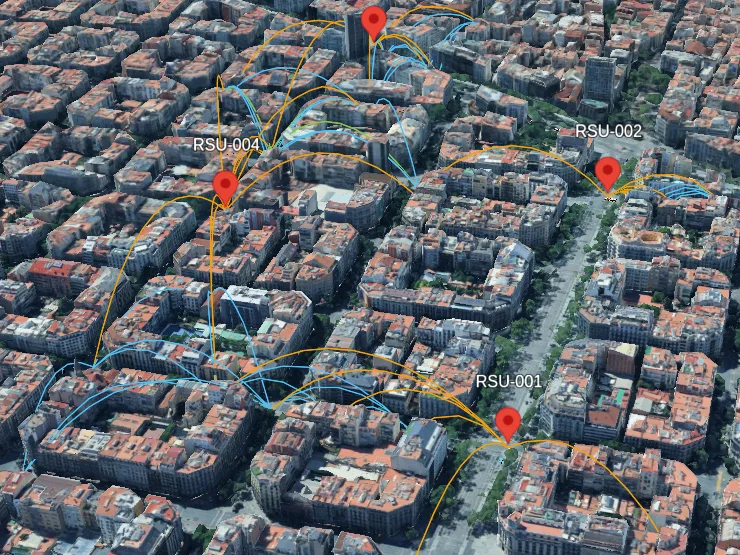 mirall.skyv2x.com Live
 Proof
Conformance, published. The edge services publish their own ETSI audit against the standard test suites, live, for anyone to read.
Live services. The stack, the decoder, the trust layer and the twin all run as public services you can reach today.
On the street this year. A roadside pilot on live European infrastructure takes the stack from lab to field in 2026.
Open the ecosystemFAQ
Tell us what runs at your intersections today. We'll tell you what it takes to have them talking to vehicles.